Soundproofing
How do you soundproof a wall so it actually works?
To soundproof a wall you combine four things: more mass, separation from the existing wall, sound-absorbing insulation in the gap and airtight sealing. In practice that usually means a new independent lining built slightly away from the wall, finished with dense acoustic plasterboard, and it only works as well as the gaps and side routes allow.

Wojtek Pankowski, Retrofit AssessorUpdated 1 October 2026 · 6 min read
On this page 9 sections
- How does sound get through a wall?
- What actually makes a wall quieter?
- Which wall soundproofing options work best?
- What does a well built soundproof wall look like?
- What soundproofing doesn't work?
- What can I try before building a new wall?
- Why do some soundproofed walls still let noise through?
- How much space and money does soundproofing take?
- How do I plan a wall soundproofing job?
How do you soundproof a wall?
Build a new lining that is heavy, separated from the existing wall and airtight. The most effective option is an independent stud wall set a small gap away from the party wall, filled with acoustic mineral wool and finished with two layers of dense plasterboard, with every gap and socket sealed. Thin panels and paints make little difference.
How does sound get through a wall?
Sound gets through a wall by making it vibrate. Your neighbour's voice or television pushes the air, the air pushes their side of the wall, the wall shakes very slightly, and your side passes that movement on to the air in your room.
There are two kinds of noise to think about:
- Airborne sound: voices, television, music, a barking dog. It travels through the air and then through the structure.
- Impact sound: footsteps, doors banging, things dropped on the floor. It starts in the structure itself and travels through floors, joists and walls.
Wall soundproofing mainly deals with airborne sound. Impact noise from above is a floor and ceiling problem, and needs a different approach.
What actually makes a wall quieter?
Four principles, used together. Leave one out and the result is usually disappointing.
- Mass: heavier layers are harder for sound to shake. Dense acoustic plasterboard is heavier than standard board.
- Decoupling: a new lining that does not touch the old wall, or touches it only through flexible fixings, stops vibration passing straight through.
- Absorption: acoustic mineral wool in the gap soaks up sound bouncing between the two layers.
- Airtightness: sound goes through gaps like water. An unsealed socket box or a gap under the skirting can undo a lot of good work.
Which wall soundproofing options work best?
The more separation and mass you can fit, the better it performs. This is the honest trade-off every soundproofing job comes down to: performance against the room space you are willing to give up.
| Option | Space taken | Typical improvement | Best for |
|---|---|---|---|
| Sealing gaps, sockets and skirting | None | Small, sometimes surprising | Always the first step |
| Extra plasterboard fixed straight to the wall | About 15–25mm | Small | Very light noise only |
| Resilient bars or clips with dense board | About 50–75mm | Moderate | Voices and television |
| Independent stud wall with a gap, mineral wool and two layers of dense board | About 100–150mm | Largest | Music, loud voices, persistent noise |
These are typical ranges. The actual result depends heavily on the existing wall and on the routes sound takes around it.
What does a well built soundproof wall look like?
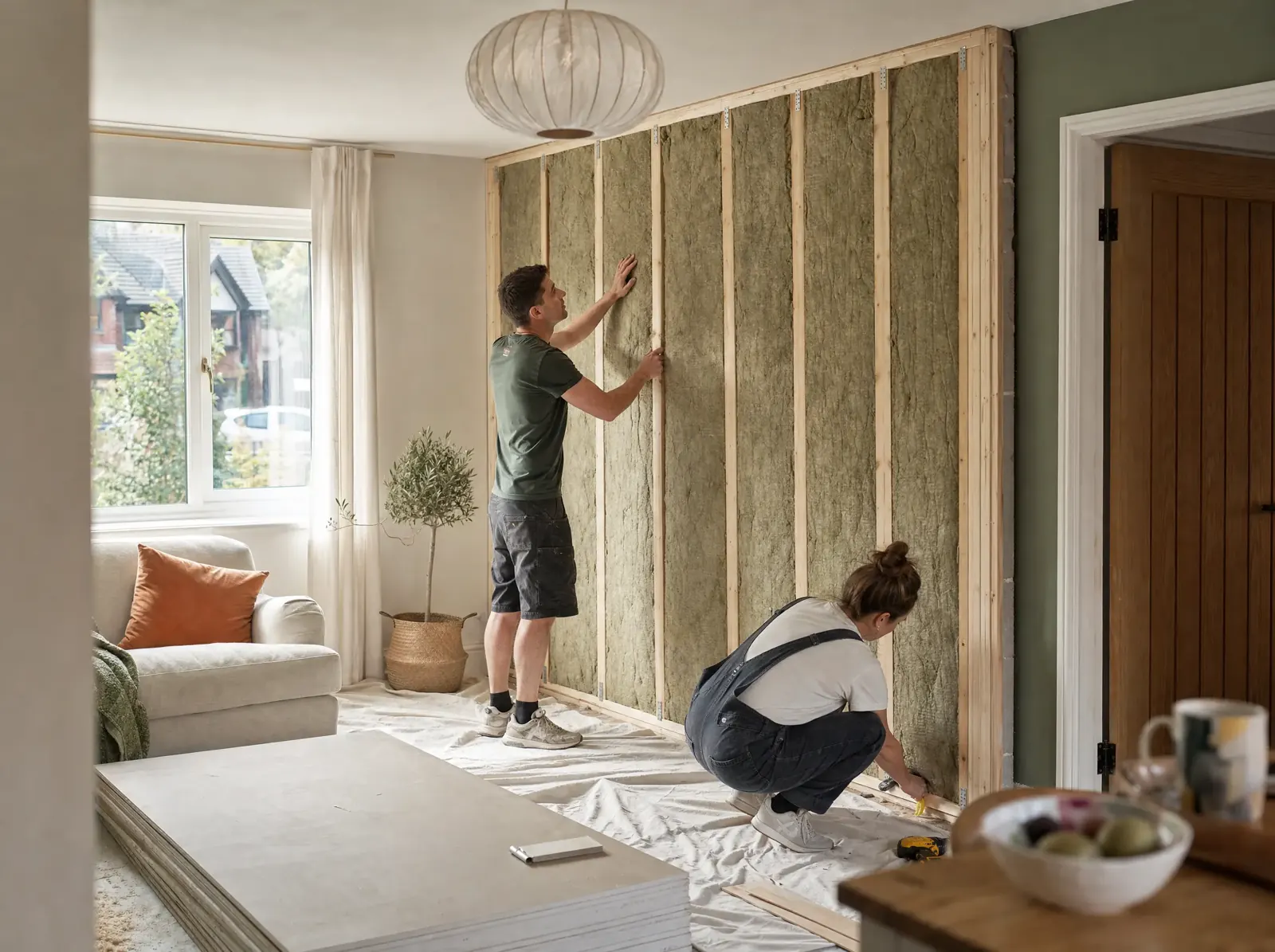
A good independent wall is a second, separate wall standing just in front of the first. Every layer has a job, and the details at the edges matter as much as the materials.
- Seal the existing wall first: fill cracks, open joints and old socket holes.
- Build a free-standing frame of timber or metal studs, fixed to the floor and ceiling but not to the party wall, leaving a small air gap.
- Isolate the frame at the floor, ceiling and side walls with acoustic strips so vibration does not pass into the structure.
- Fill the frame with acoustic mineral wool.
- Fix two layers of dense acoustic plasterboard with staggered joints, rather than one layer of standard board.
- Seal the perimeter with acoustic sealant and use sealed or surface-mounted socket boxes.
- Plaster the face and refit the skirting.
Any screw that bridges from the new wall into the old one creates a short cut for vibration, which is why the fixing is as important as the board. Careful plasterboarding is the part you see; the separation behind it is the part that works.
What soundproofing doesn't work?
Anything thin and light. Sound is stopped by mass and separation, and thin products have neither.
- Foam panels and egg boxes reduce echo inside a room. They do almost nothing to stop sound coming through the wall.
- Soundproof paint and wallpaper add a tiny amount of mass, far too little to notice.
- Plasterboard screwed straight onto the wall adds some mass but stays connected, so vibration passes straight through.
- A soundproof wall with gaps around it, such as unsealed sockets or an open skirting line, lets sound walk round the new lining.
Worth knowingSound is measured in decibels, and the scale is not linear. A reduction of about 3 dB is barely noticeable, 5 dB is clearly noticeable, and 10 dB sounds roughly half as loud. That is why small products that promise a few decibels rarely feel worthwhile, while a well built independent wall can make a real difference.
What can I try before building a new wall?
Find and seal the leaks, and move the loudest things. These steps cost little and tell you a lot about where the sound is getting in.
- Listen at the wall at different heights and at the corners. Noise that is loudest at the ceiling or floor edges points to a side route.
- Check for back-to-back sockets on the party wall. They leave a hole through most of the wall's thickness.
- Seal gaps at skirting boards and around pipes with an acoustic or flexible sealant.
- Look in the loft. In some older houses the party wall is incomplete or has gaps above the ceiling line.
- Put a full bookcase or wardrobe against the wall. It helps a little with voices.
- Talk to your neighbour about moving a television or speaker off the shared wall, or putting a washing machine on anti-vibration feet.
Why do some soundproofed walls still let noise through?
Usually because the sound is taking a different route. This is called flanking: sound travels along floors, ceilings, side walls and joists, bypassing the wall you treated.
A perfectly built new wall cannot help if the noise runs through the floorboards underneath it or through a shared ceiling void. That is why the survey matters more than the product. My guide on why you can hear your neighbours through the walls explains flanking in more detail.
How much space and money does soundproofing take?
More than most people expect, so it is worth knowing before you start. An effective independent wall usually takes 100 to 150mm off the room, sockets and radiators need moving, skirting and coving are refitted, and the room needs replastering and redecorating.
It is a significant investment. As an industry reference, the specialist firm Quietco says around 80% of its domestic projects fall between £5,000 and £20,000, although one wall in one room will usually sit at the lower end of whole-project figures. I price each job after a free home visit, once I know which walls and routes are involved.
How do I plan a wall soundproofing job?
I start by finding how the noise is actually travelling, not by picking a product. At the home visit I listen with you, check the wall construction, sockets, floors, ceilings and loft, and ask when the noise happens and what it sounds like.
From there I design the build-up to suit the space you can give up, explain what improvement is realistic, and organise any electrician needed for sockets. The finished wall is plastered and ready to decorate. You can read more on my wall soundproofing page and see how the process works from first call to handover.
Common questions
Can you soundproof a wall without losing space?
Only partly. Sealing gaps and back-to-back sockets takes no space and is always worth doing. A thin extra layer of dense plasterboard takes around 15–25mm but gives a small improvement. Real reductions in noise need separation between the old and new surfaces, and that needs depth, usually 50mm at the slimmest and 100 to 150mm for the best results.
Is soundproofing one wall enough?
Sometimes, if almost all the noise comes straight through a single party wall. Often it is not, because sound also travels through the floor, ceiling and side walls. Listening at the edges of the room and checking the loft helps show whether one wall will do. A proper survey should tell you honestly before you spend money.
Does soundproofing stop bass from music?
Low bass notes are the hardest sound to stop because they carry a lot of energy and shake whole structures. Heavy, separated walls with a deep cavity perform best against them, but even a good system reduces bass less than voices. If loud music is the main problem, it is also worth speaking to your neighbour about moving speakers off the shared wall.
How long does it take to soundproof a wall?
It depends on the build-up and on moving sockets, radiators and skirting, plus plastering and drying time. A single wall in one room is usually a matter of days rather than weeks. I give you a clear programme in the written quote after the home visit, including when the room will be ready to decorate.
Do I need my neighbour's permission to soundproof my side?
Not usually, if all the work is on your side of the party wall and does not cut into it. Some work that cuts into a party wall can fall under the Party Wall etc. Act 1996, which requires notice to your neighbour, so check before starting if in doubt. An independent wall standing on your side generally avoids cutting into it at all.