
Soundproofing · Sutton Coldfield, Walsall & nearby
Wall soundproofing, designed around how the noise gets in.
Wall soundproofing works when it is designed around how the noise actually reaches you: more mass, a new layer separated from the old wall, absorbent insulation in the gap and every edge sealed. I start with a survey in your home and tell you honestly what improvement is realistic before you spend anything.
Free home visit. Written quotation. No pressure.
Rated 5 out of 5 on Google
 Wojtek, Retrofit AssessorAssesses, designs and fits every job himself
On this page 9 sections
- Is noise through the wall wearing you down?
- Is it airborne or impact noise?
- What actually works to soundproof a wall?
- What doesn't work?
- Independent wall or resilient system: which do you need?
- Why does noise sometimes get round a new wall?
- How much space and disruption should you expect?
- How much does wall soundproofing cost?
- What result can you realistically expect?
Can you soundproof a wall between you and your neighbours?
Yes, noise through a party wall can usually be reduced a great deal, but not with foam or one extra sheet of plasterboard. It takes a new layer that adds mass, stands apart from the existing wall, has mineral wool in the gap and is sealed at every edge. Expect a calmer, quieter room, not total silence.
Is noise through the wall wearing you down?
If you are reading this, you have probably had enough. Wall soundproofing is usually the last step after talking to the neighbours, moving the bed to another wall or sleeping in the spare room, and none of it has really worked.
It might be music or a television late at night, raised voices, a dog that barks when they go out, or children running up and down the stairs. Some people hear a busy road or a railway line more than next door. Even in quiet spells you find yourself waiting for the next disturbance, and a home you love stops feeling like yours.
Many people in Sutton Coldfield, Walsall and Great Barr reach the point where it feels like soundproofing or moving. Before you decide either way, it helps to know what soundproofing really involves, what it can achieve and what it costs. That is what this page is for.
Is it airborne or impact noise?
The type of noise decides the solution. Airborne noise travels through the air and makes the wall vibrate; impact noise starts as a knock or footstep on the structure itself and travels through the building.
| Airborne noise | Impact noise | |
|---|---|---|
| Examples | Voices, television, music, barking | Footsteps, doors slamming, things dropped, stairs |
| How it travels | Through the air, then through the wall and any gaps | Through floors, joists and walls as vibration |
| What a wall build-up does | Can reduce it considerably | Helps a little; the floor or ceiling usually needs treating |
| Hardest part | Deep bass and low voices | Heavy footfall on a shared staircase or floor |
Most complaints about neighbours in semi-detached and terraced homes are airborne noise through the party wall, and that is what a wall system treats best. If your main problem is footsteps from above, the answer is usually in the ceiling or floor, and I will tell you that rather than sell you a wall.
What actually works to soundproof a wall?
Effective wall soundproofing combines four principles. Leave one out and the result is usually disappointing, because sound takes the easiest path it can find.
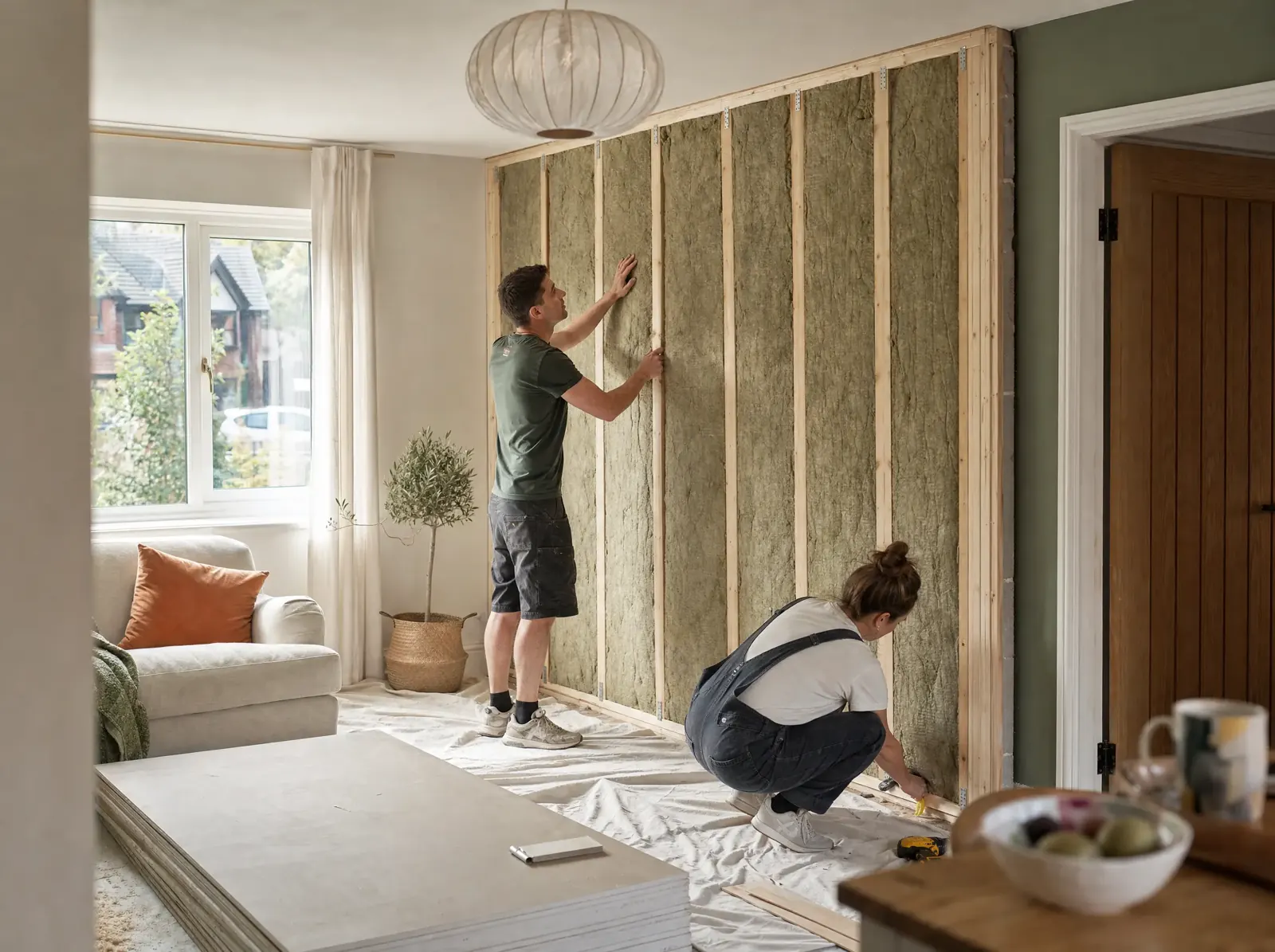
- Mass. Heavy, dense layers are harder for sound to shake. This usually means two layers of dense acoustic plasterboard rather than one standard board.
- Decoupling. The new wall is separated from the old one, either on its own frame with a small gap or on resilient fixings, so vibration cannot pass straight through.
- Absorption. Mineral wool in the cavity soaks up sound energy that would otherwise bounce around inside it.
- Sealing. Gaps around the edges, sockets and pipes let sound leak through. Perimeters are sealed with acoustic sealant and sockets are moved or boxed in.
None of these is exotic. They are the same principles used to meet the standards for walls between new homes. The skill is in putting them together carefully, because a well-designed wall with one unsealed gap can lose much of its benefit. I explain the principles in more depth in my guide on how to soundproof a wall.
What doesn't work?
Most quick fixes do very little for noise coming from next door. They are cheap for a reason, and I would rather you did not waste money on them.
- Acoustic foam panels. They reduce echo inside a room, which is why studios use them. They are far too light to stop sound passing through a wall.
- Egg boxes. No measurable effect on noise from next door.
- One extra sheet of plasterboard fixed straight to the wall. It adds a little mass, but the vibration still passes straight through the fixings.
- Thin "soundproof" boards, acoustic paint and wallpaper. They take the edge off very slightly at best.
- Treating one wall when the noise comes round it. Money spent on the wrong surface.
Independent wall or resilient system: which do you need?
There are two main ways to build a soundproof lining, and the choice is a balance between performance and the space you are willing to give up.
| Resilient system | Independent wall | |
|---|---|---|
| How it works | Boards fixed to resilient bars or clips that absorb vibration | A new stud wall standing off the old one, not touching it |
| Space lost | Roughly 50–75mm | Roughly 100–150mm or more |
| Best for | Voices and television, where space is tight | Louder music, persistent noise, deeper sounds |
| Low bass | Limited improvement | Noticeably better |
| Disruption | Moderate | Greater: more to move and refit |
A resilient system suits people who want to take the edge off everyday noise without losing much room. An independent wall is the stronger choice when the noise is loud, frequent or low. The frame is built from the floor and ceiling on your side, filled with mineral wool, then finished with two layers of dense board, often built on the same principles as good plasterboarding, with far more attention to sealing.
Why does noise sometimes get round a new wall?
Because sound does not only travel through the party wall. It also moves around it, through what are called flanking paths, and a survey is how you find them.
Common flanking paths in older semis and terraces include:
- floor joists that run through the party wall into next door
- ceilings and a shared loft space with no proper separation above
- side walls and chimney breasts connected to the party wall
- back-to-back sockets and switches, which are effectively holes in the wall
- gaps at skirting level and around pipes
Approved Document E sets sound insulation standards for walls between new homes and conversions. It does not require older homes to meet them, and many 1930s party walls fall well short, partly because of these weak connections. If you have not read it, my guide on why you can hear your neighbours through the walls explains this in more detail.
How much space and disruption should you expect?
Expect to lose roughly 50–150mm from the treated wall, and for the room to be out of use while the work is done. It is building work, not a quick lining.
Skirting boards come off, sockets and switches are moved or re-fitted, and a radiator on that wall may need to come off and go back on. I organise the electrician and plumber if you want me to, so you are not coordinating trades. Floors and furniture are protected, and we tidy every day.
For a full independent wall in one room, allow in the region of one to two weeks, including finishing. You get the room back plastered and ready to decorate. The exact time depends on the design, the length of the wall and what needs moving.
How much does wall soundproofing cost?
Proper soundproofing is a significant investment. As a market reference, the specialist firm Quietco states that around 80% of its domestic projects fall between £5,000 and £20,000.
I price each job after the survey because the cost depends on the system, the length and height of the wall, how many flanking paths need attention and what has to be moved. What I can promise is a written quote that explains what you are paying for, and an honest view on whether the likely improvement is worth it for you.
For many people it is still far less, and far less upheaval, than moving house.
What result can you realistically expect?
A well-designed and carefully built system can make noise quieter, softer and far less intrusive, so the room feels private again. It will not usually make a neighbour's noise disappear completely, and deep bass is always the hardest part.
My background is plastering, dry lining and building physics, so the construction side of soundproofing is familiar ground. Every design follows the established principles above, starts with a survey and comes with realistic expectations written into the quote.
The survey matters more here than in almost any other job I do. I want to hear the noise described in your words, see where the party wall meets the floor, ceiling and chimney breast, and check what sits on the other side of the sockets. Sometimes the honest conclusion is that a ceiling or a secondary window will help more than a wall, and I would rather tell you that than build the wrong thing. You can see how a job runs from first visit to handover on my how it works page.
How the job runs.
Free home visit
I listen to what you are hearing, when and from where, and look at the wall, floor, ceiling and the connections around them.
Noise assessment
We work out whether the noise is airborne or impact, and which paths it is taking into the room.
Design and written quote
You get a recommended system, the space it will take, the disruption involved and a realistic expectation of the result.
Careful build
Room protected, skirting and fittings removed, frame or resilient system fitted, mineral wool, dense boards and every edge sealed.
Finish and follow-up
Plastered and ready to decorate, a handover inspection, then I call about four weeks later to hear how the room feels.
Homeowners who called me.
Real reviews from homeowners across the West Midlands, all 5 stars on Google, where you can read every one.
“We had insulation done in our main bedroom, outside wall including bay. From his initial visit, to quotation process and actually doing the work, he was very efficient. It was a pleasure to have Wojtek working in our house.”
“We had our house insulated recently and the difference is honestly amazing. Before, it used to take forever to warm the house up, we’d got to the point where we were even talking about selling because it was just that cold.”
“We’d had black mould forming on our bay window for years and had almost given up trying to clean it off. Nothing we tried ever worked. Then we came across Wojtek at aPlastering.”
“We recently had two rooms insulated by aPlastering, and honestly, they were brilliant from start to finish. They explained everything clearly, the communication was great, and the price was straightforward with no surprises.”
“Our experience with aPlastering was exceptional from start to finish. Wojciech did a thorough survey prior to providing a quote and was crystal clear on what was required. The price was fair for the work required.”
“A very professional and reliable service throughout. From initial enquiry to completion, communication was prompt, with a clear quotation and timeline provided.”
“Excellent professional service, great time keeping, and perfect job. I had insulated plasterboard fitted, soundproof plasterboard and all skimming to a large ground floor, excellent finish throughout and more importantly 3 years in and no cracks.”
“We were let down last minute and he came out to provide a quote the very same day and had our bedroom beautifully plastered the following day, all to an incredibly high standard.”

Free download · 16 pages
Why is my room so cold?
Most cold rooms in 1930s and Victorian homes are cold because their outside walls lose heat fast and stay cold on the surface. This free guide from Retrofit Assessor Wojtek Pankowski helps you find out what's happening in your home and what to do about it, before you spend a penny.
Get the free guideYour questions, answered.
Anything else, ring me on 07763 789272. Happy to talk it through.
Get a free quoteWill soundproofing stop all noise from my neighbours?
Usually not completely, and I would be wary of anyone who promises that. A well-built system can make voices and television much quieter and far less intrusive. Deep bass and impact noise are harder to control. At the survey I explain what improvement is realistic for your wall, so your expectations match what the work can deliver.
How thick is a soundproof wall lining?
A slim resilient system usually adds roughly 50–75mm to the wall. An independent wall on its own frame typically adds 100–150mm or more, because the gap and extra depth are what give it better performance. I measure the room at the survey and show you how much space each option would take before you decide.
Does acoustic foam stop noise from next door?
No. Acoustic foam absorbs echo inside a room, which is why it is used in studios and home cinemas. It is too light to block sound passing through a wall from next door. Reducing that kind of noise needs mass, separation from the existing wall, mineral wool in the cavity and careful sealing at every edge.
Can you soundproof against footsteps from upstairs?
Footsteps are impact noise, and they travel through the floor and ceiling structure rather than through a wall. Treating the wall will not help much. The usual answer is a ceiling system on your side or treatment of the floor above, which in a flat depends on your neighbour. I will tell you honestly which route makes sense.
Can you block bass from music next door?
Low bass is the hardest sound to control, because it carries a lot of energy and passes through light constructions easily. More mass, a wider gap and an independent frame all help. An independent wall is usually the better choice here than a slim system, but even then bass is reduced rather than removed completely.
Do I need my neighbour's permission to soundproof a party wall?
An independent wall built on your side, fixed to your own floor and ceiling rather than into the party wall, generally does not need your neighbour's agreement. If any part of the design would cut into the party wall itself, I will flag it early, because the Party Wall etc. Act 1996 may then require you to serve notice.
How long does wall soundproofing take?
For a full independent wall in one room, allow in the region of one to two weeks, including plastering. A slimmer resilient system is usually quicker. The time depends on the length of the wall, how many sockets or radiators need moving and whether other flanking paths such as the ceiling also need treating. Your quote sets out the timetable.
You might also need.
Let's find out how the noise is getting in.
Free, no-obligation quote. I'll come and look at the room, tell you honestly what's going on and give you a written quotation.
- TodayI read your message and call or WhatsApp you back.
- This weekA free home visit at a time that suits you.
- Within daysA clear written quote. No pressure, no chasing.
Wojtek, Retrofit AssessorUsually replies the same day
Tell me what's going on. It takes about a minute.
Get a free quote 07763 789272 Or send photos on WhatsApp