Mould & damp
Told you need a damp proof course? Check this first
If someone has told you that your house needs a new damp proof course, it is worth getting a second opinion before paying for injection. Genuine rising damp exists, but black mould, damp corners and peeling paint on an outside wall are far more often condensation or water coming in from outside, and those need a different fix.

Wojtek Pankowski, Retrofit AssessorUpdated 19 October 2026 · 9 min read
On this page 8 sections
- What are the three kinds of damp?
- How can I tell which one I have?
- Why can a moisture meter reading be misleading?
- Does a 1930s house usually have a damp proof course?
- What about the plaster after a damp proof course?
- What should I ask before paying for injection?
- How do I look at a damp wall differently?
- What should I do next?
Do I really need a new damp proof course?
Possibly, but check the pattern first. Rising damp stays low, usually below about 1 metre, leaves a tide mark with white salts and is there all year. Black mould high in corners, behind furniture and around windows that is worst on winter mornings is condensation. Patches that grow after rain are penetrating damp. Only the first is fixed by a damp proof course.
What are the three kinds of damp?
Almost every damp problem I see in a house falls into one of three groups, sometimes two at once. They look similar from a distance, but they come from different places and need different fixes.
| Rising damp | Penetrating damp | Condensation | |
|---|---|---|---|
| Where the water comes from | The ground, drawn up into the base of the wall | Outside, through the wall, roof, window or a leak | The air inside the house, landing on cold surfaces |
| Where you see it | Low on ground floor walls, from the skirting up | Anywhere, often near gutters, bay roofs, chimneys and window sills | Cold corners, around windows, behind furniture, on outside walls upstairs and down |
| How high | Usually below about 1 metre | Any height | Any height, often near the ceiling |
| When | All year, slowly changing | After rain, especially wind-driven rain | Worst in winter and first thing in the morning |
| What it looks like | Tide mark, white fluffy salts, crumbling plaster, rotting skirting | A defined wet patch, staining, sometimes a tide mark | Black spots of mould, water on windows, musty smell |
| Typical fix | Find and fix the cause, sometimes a new damp proof course | Repair the outside: gutters, pointing, flashing, render, bay roof | Ventilation and warmer wall surfaces |
A new damp proof course only deals with the first column. If the problem is in the third, injecting the base of the wall will not touch it.
How can I tell which one I have?
You can learn a lot in ten minutes with your own eyes. Walk round the room and answer these honestly:
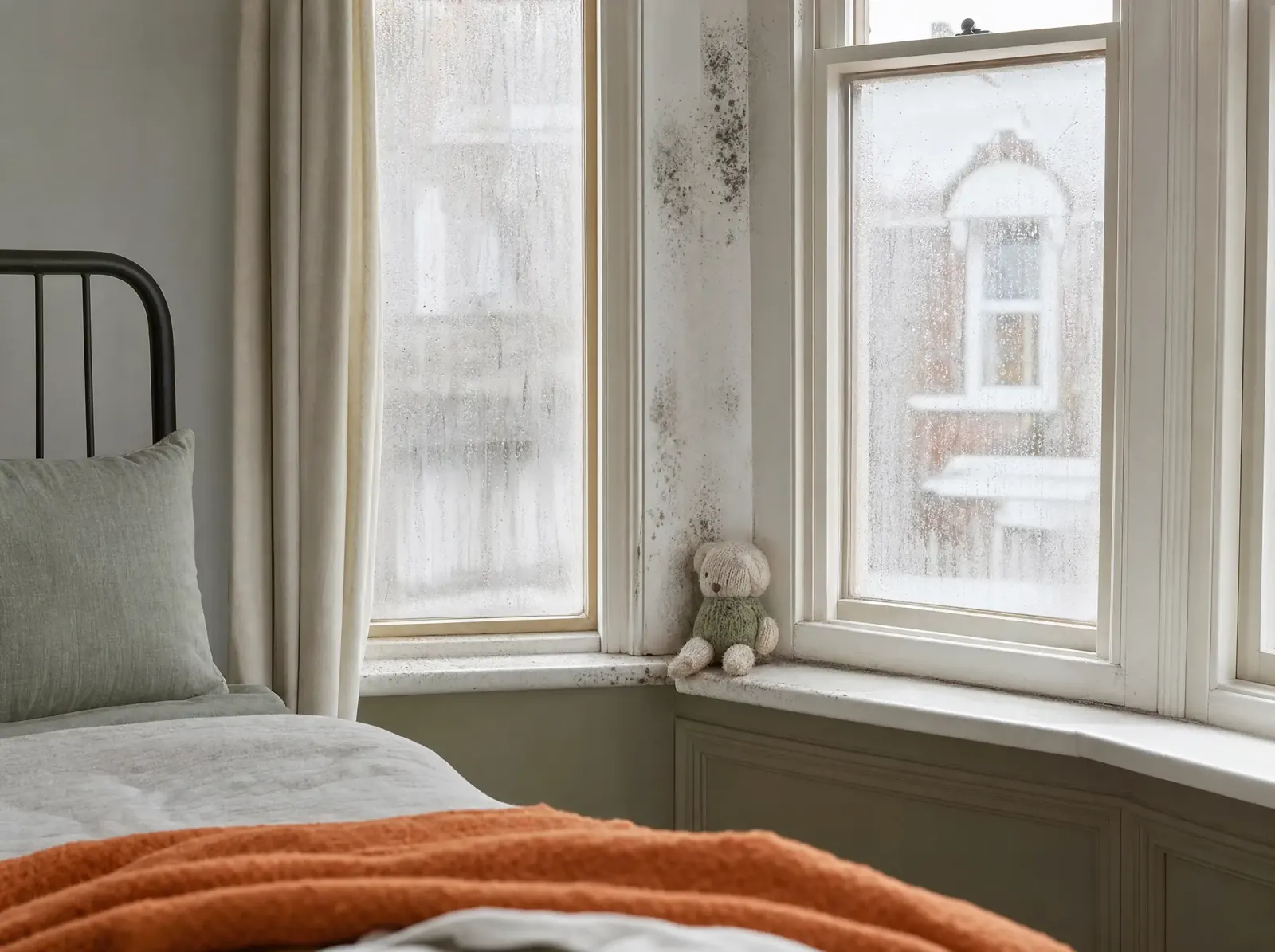
- Where is the mould? Black mould growing high up, in the corner where the outside wall meets the ceiling, is condensation. Rising damp rarely produces black mould high on a wall.
- Is it upstairs? Damp in a first floor bedroom cannot be rising from the ground. It is condensation or water getting in.
- How high is the staining? A band from the skirting up to roughly knee or waist height, level along the wall, with a tide mark on top, points towards rising damp or bridging.
- Are there salts? White, fluffy or crystalline deposits on the plaster are salts carried up from the ground or from the masonry. Condensation mould is black or grey spots without that crust.
- When is it worst? Worse after a week of rain points outside. Worse on cold, still winter mornings with streaming windows points to condensation.
- What is behind it? A rectangle of mould behind a wardrobe or bed is condensation. My guide to mould behind the wardrobe explains why.
Take photos, note the dates and the weather, and keep a cheap digital hygrometer in the room for a week. Readings above 65% every morning make condensation very likely.
Why can a moisture meter reading be misleading?
Because most handheld moisture meters are designed for timber. They work by measuring electrical resistance, and on plaster and brick they can read high for reasons that have nothing to do with rising water. Salts in old plaster conduct electricity. So do foil-backed wallpaper, some paints and a cold surface with a film of condensation on it.
A meter is useful for comparing one part of a wall with another. It is not, on its own, proof of rising damp. A more reliable diagnosis looks at the pattern of the damp, the outside of the wall, the ground levels, and where needed takes samples from inside the masonry rather than just touching the surface. If you have been shown a red reading on a meter and nothing else, it is fair to ask what else was checked.
Does a 1930s house usually have a damp proof course?
Most do. Houses built from the late Victorian period onwards were generally built with a physical damp proof course, often a layer of slate or bitumen felt in a mortar joint a couple of courses above the ground. In many 1930s semis around Walsall, Great Barr, Erdington and Sutton Coldfield it is still there and still working.
When those houses do get damp low on the walls, the cause is more often something that lets water bypass the damp proof course:
- a patio, path or flower bed built up above the damp proof course level, which should normally sit at least 150mm above the ground outside;
- render or pebble dash taken down over the damp proof course to the ground;
- a leaking downpipe or gully soaking the same corner every time it rains;
- internal plaster or a solid floor that bridges past it;
- blocked air bricks under a suspended timber floor.
These are fixed by lowering the ground, clearing the bridge or repairing the leak, often for much less than a new damp proof course.

What about the plaster after a damp proof course?
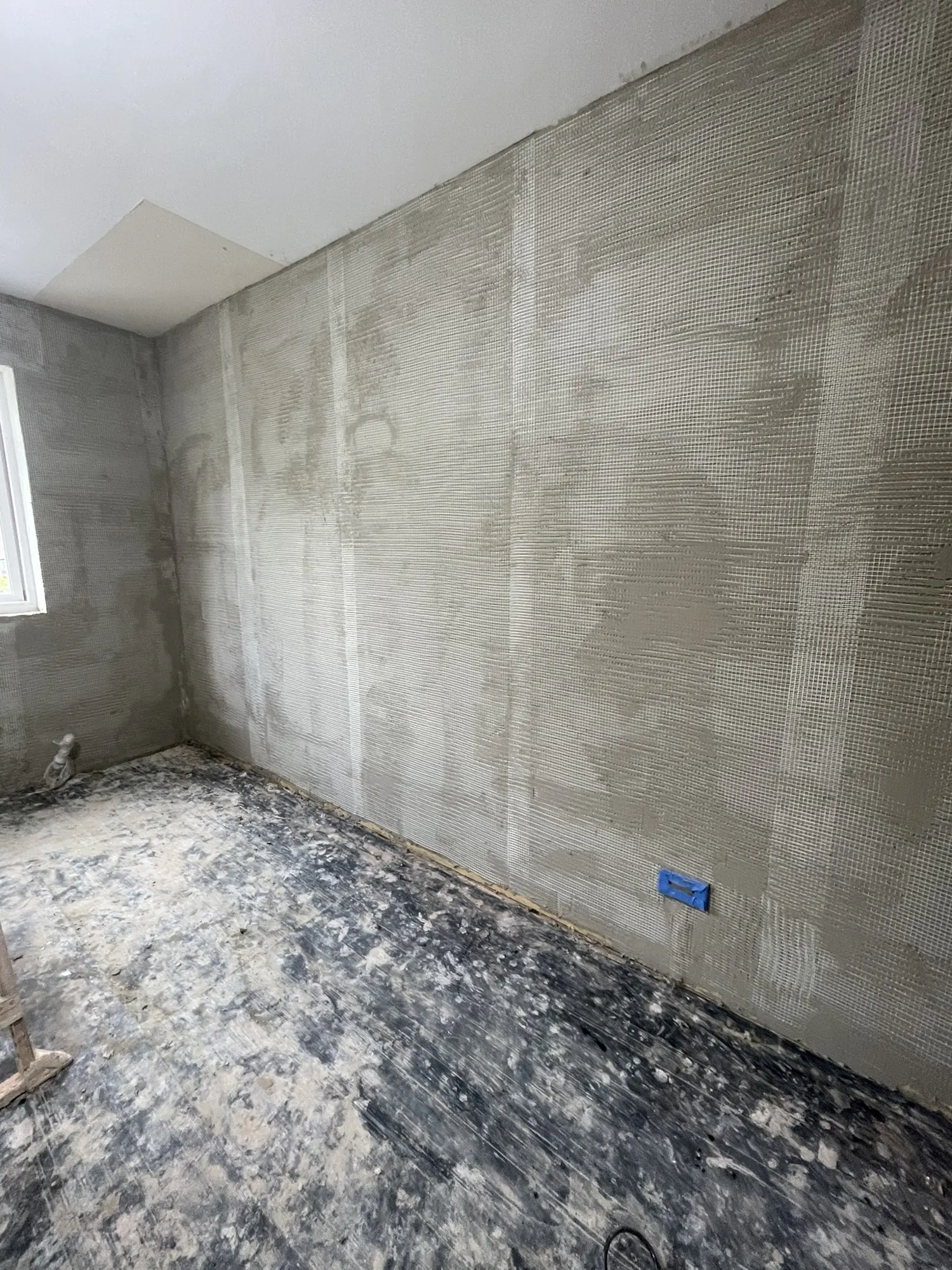
This is the part people are rarely told about. Injection is usually sold together with stripping the plaster and replacing it with a dense, waterproof render and a gypsum finish. On a solid brick wall that can trap moisture in the brickwork rather than let it dry out, and push the damp sideways or upwards.
If plaster really has been spoiled by salts, it does need replacing. On older solid walls I usually prefer a breathable lime plaster, which lets the wall dry out and handles small amounts of moisture far better than gypsum. I explain the difference in lime plaster vs gypsum, and you can see the work on my lime plastering page.
What should I ask before paying for injection?
Most damp specialists are honest and good at what they do. Still, whoever diagnoses the problem is often also the person selling the treatment, so it is sensible to ask a few questions before you sign:
- Can you show me in writing why this is rising damp and not condensation or penetrating damp?
- What did you measure, with what instrument, and where? Were any samples taken from inside the wall?
- Where is the existing damp proof course, and why has it failed?
- Have you checked the ground levels, gutters, downpipes and render outside?
- What plaster will go back on, and will the wall still be able to dry out?
- What exactly does the guarantee cover, and does it cover condensation?
If the answers are clear and the evidence points to rising damp, go ahead with confidence. If they are vague, get another view.
How do I look at a damp wall differently?
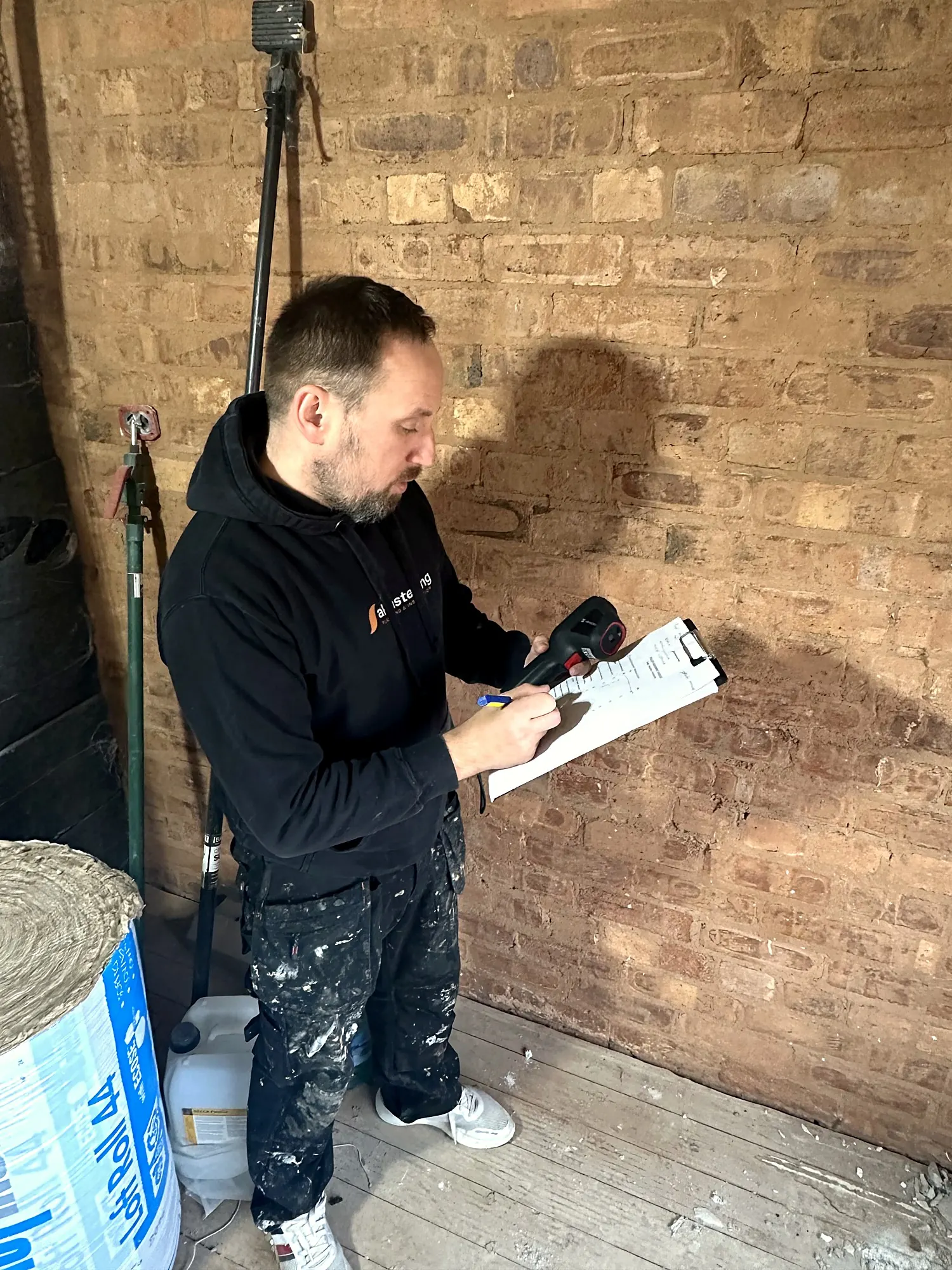
I do not sell damp proof injection or chemical treatments, so I have no reason to find rising damp where there is none. As a Domestic Energy Assessor and Retrofit Assessor my job on a visit is to work out where the water is coming from: I look at where the damp is and where it is not, check the outside of the wall, the ground levels, the gutters and the ventilation, and measure the room.
If the cause is condensation, which in cold solid wall houses it very often is, the fix is ventilation and a warmer wall surface, and that is the work I do: condensation and mould solutions, cork coating or internal wall insulation with a moisture check before any work starts. If it is a leak or bridging, I tell you what needs repairing. If it really is rising damp, I will say so plainly.
What should I do next?
Do not rush. Damp that has been there all summer will not get dramatically worse in the two weeks it takes to get a second opinion. Keep the photos and hygrometer readings, fix anything obvious outside such as a blocked gutter, and read my guide on how to stop mould coming back if the problem is black spots rather than salts.
Then book a free home visit. I will look at the wall, tell you which kind of damp I think it is and why, and put any recommendation in writing.
Common questions
Can rising damp cause black mould?
Rarely on its own. Rising damp tends to leave tide marks, salts and crumbling plaster low on the wall. Black mould needs a cold, damp surface and still air, which is why it grows in corners, around windows and behind furniture. If you have black mould upstairs or high on a wall, it is almost certainly condensation.
Is rising damp a myth?
No, it is real, but it is less common than it is diagnosed. Many cases put down to rising damp turn out to be bridging by raised ground, a leak, or condensation. A careful diagnosis that looks at the pattern of the damp and the outside of the building is worth more than a single meter reading.
My mortgage survey says there is damp. What now?
Surveyors often flag high meter readings and recommend a specialist report. That is a sensible precaution, not a diagnosis. Ask for someone to look at the cause, check the outside of the house and explain whether it is rising damp, penetrating damp or condensation before any treatment is quoted.
Will a new damp proof course stop condensation?
No. Condensation comes from moisture in the air inside the house landing on cold surfaces. A damp proof course stops ground water rising through the base of a wall. They are separate problems, and the fix for condensation is ventilation and warmer walls.
Can I insulate a wall that has rising damp?
Not until the damp is dealt with. Insulating a wet wall can trap moisture. Before any internal wall insulation I check the wall for damp and leaks, and I run a moisture check on the new build-up so the wall can still dry out.
Do you do damp proofing?
I do not install chemical damp proof courses. I diagnose where the damp is coming from, and I fix condensation and cold walls with ventilation, cork coating, internal wall insulation and lime plaster. If your wall genuinely needs a damp proof course, I will tell you so.